
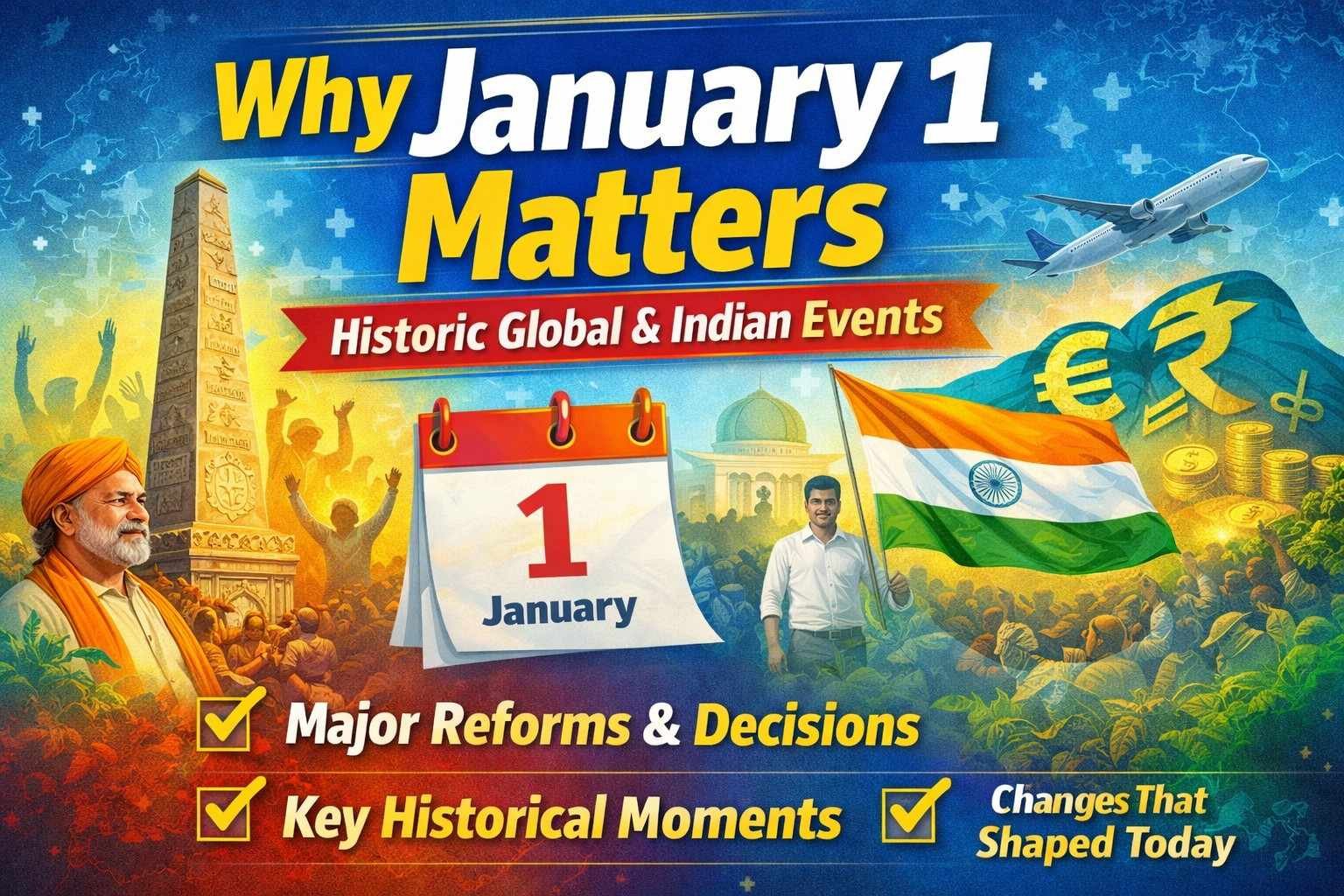
January 1 is universally recognized as the dawn of a New Year, but for India and the world, it is far more than just a page-turning event on the calendar. From the birth of scientific legends to the restructuring of global economies, this date serves as a milestone for human progress.
Below is a detailed look at why January 1 holds a unique place in our collective history.
1. The Global Symbol of New Beginnings
The primary significance of January 1 is its role as New Year’s Day in the Gregorian calendar.
- Historical Roots: The tradition dates back to 46 BCE when Julius Caesar introduced the Julian calendar. He chose January 1 to honor Janus, the Roman god of beginnings, whose two faces allowed him to look back at the past and forward into the future.
- The Gregorian Shift: In 1582, Pope Gregory XIII refined the calendar to better align with the solar year, cementing January 1 as the civil New Year for most of the world.
Read More: Strong Growth in PG Medical Seats as NMC Expands Opportunities for Future Specialists
2. Why January 1 Matters for India
While India celebrates various regional New Years (like Baisakhi, Ugadi, or Pohela Boishakh), January 1 has become a vital secular and administrative milestone.
Historical Turning Points
- Battle of Bhima Koregaon (1818): Every year, thousands gather at the Victory Pillar (Vijay Stambha) to commemorate this battle. It is a symbol of courage and social dignity for the Dalit community, marking a stand against caste oppression.
- Empress of India (1877): Queen Victoria was officially proclaimed the Empress of India at the Delhi Durbar, a major moment in British colonial history.
- The Kashmir Ceasefire (1949): A UN-brokered ceasefire took effect on this day, ending the first major conflict between India and Pakistan.
- National Animal (1972): The Bengal Tiger was officially chosen as the national animal of India.
Birth of Legends
- Satyendra Nath Bose (1894): The world-renowned physicist famous for the “Bose-Einstein Statistics.”
- Mahadev Desai (1892): Mahatma Gandhi’s personal secretary and a key figure in the independence movement.
- Vidya Balan & Nana Patekar: Icons of Indian cinema who share this birthday.
3. Global Milestones: Shaping the Modern World
January 1 has been the “Launch Day” for massive global shifts in politics and technology.
- The Birth of the Internet (1983): On this day, the ARPANET officially switched to using the TCP/IP protocol, effectively marking the birth of the modern Internet.
- The Euro (1999): Eleven European nations adopted the Euro as their common currency, creating a massive economic bloc.
- The World Trade Organization (1995): The WTO was established to regulate international trade.
- Haitian Independence (1804): Haiti became the first Black republic in the world to declare independence from colonial rule.
4. Key Changes in India (January 1, 2026)
As of today, several major administrative and financial changes have taken effect in India:
- 8th Pay Commission: New salary structures and Dearness Allowance (DA) updates for government employees have begun.
- Banking Reforms: Credit scores are now updated every 15 days (instead of monthly) to allow for faster loan approvals.
- PAN-Aadhaar Mandatory: Linking these is now compulsory for almost all banking and government services.
- Digital Verification: Messaging apps like WhatsApp now require a valid SIM card for verification to curb fraud.
Summary Table: Key Events on January 1
| Year | Event | Significance |
| 1818 | Battle of Bhima Koregaon | Landmark for social equality in India. |
| 1863 | Emancipation Proclamation | A turning point in the fight against slavery in the US. |
| 1894 | Birth of S.N. Bose | Foundational work for modern Quantum Physics. |
| 1949 | Kashmir Ceasefire | Ended the first Indo-Pak war. |
| 1983 | Birth of the Internet | TCP/IP becomes the standard protocol. |
| 1995 | WTO Founded | Established global trade rules. |
| 1999 | Euro Introduced | Unified European currency. |
January 1 is a day when the world hits the “reset” button. Whether it’s through personal resolutions or global treaties, it remains the ultimate symbol of human hope.
Important January 1 Events (History)
Very Early History
- 153 BCE — Roman consuls first began their year in office on January 1.
- 45 BCE — The Julian calendar was introduced, making January 1 the official start of the year. Wikipedia
Notable Events in Modern Times
1900s–Present
- 1960 — Cameroon became independent from France and the United Kingdom.
- 1962 — Western Samoa became independent from New Zealand and changed its name to the Independent State of Western Samoa.
- 1964 — The Federation of Rhodesia and Nyasaland was split into Zambia and Malawi.
- 1965 — The People’s Democratic Party of Afghanistan was founded.
- 1970 — The world’s most widely used computer time system (Unix time) officially began at midnight.
- 1971 — Cigarette advertisements were banned on American television.
- 1973 — Denmark, Ireland, and the United Kingdom joined the European Economic Community.
- 1976 — A bomb exploded on an airline flight over Saudi Arabia, killing everyone on board.
- 1978 — Air India Flight 855 crashed into the Arabian Sea near Bombay (Mumbai), killing all passengers and crew.
- 1979 — The United States and China established normal diplomatic relations.
- 1981 — Greece became a member of the European Community (now the European Union).
- 1982 — Javier Pérez de Cuéllar became the first Latin American Secretary-General of the United Nations.
Famous Birthdays on January 1
January 1 is the birthday of several well-known people, including:
- Satyendra Nath Bose — Indian physicist whose work contributed to major discoveries in quantum mechanics.
- Several cultural and political figures were also born on this day in history.
Observances and Holidays on January 1
- New Year’s Day — The most widely celebrated holiday around the world.
- Solemnity of Mary, the Holy Mother of God — A Christian feast day.
- In some countries like Brunei, Haiti, and Sudan, January 1 also marks Independence Day.
Why January 1 Is Special
January 1 is important because:
- It marks the first day of the year in the most widely used modern calendar (the Gregorian calendar).
- Historically, decisions, reforms, and political changes are often put into effect on this day.
- It is connected with both celebration and remembrance — from global independence moments to cultural observances.
